Tuesday, March 5, 2013

From the South to Lesotho.....


St. Paul's within The Walls

From the South to Lesotho….. and then on to Rome! That’s right, folks! I’m moving to Rome, Italy following my year here in Lesotho. You might be asking, “Jared, what will you be doing in Rome?” This is a good question. The YASC program has decided to open a new placement in Rome with the only American Episcopal Church inside the city, St. Paul’s within The Walls. After talking with the YASC office for sometime, they have decided to send me there for a second year of YASC! I am incredibly excited and blessed to have this opportunity.

Jill, Fr. Austin, and Aja
As I said, the placement is with St. Paul’s within The Walls Episcopal Church, which just happens to be the church where my friend, The Rev. Austin Rios, is the rector! Fr. Rios was a priest in the Diocese of Western NC, my home diocese, before accepting a call to Rome last year. He is also a former YASCer who served his year in Mexico City. I’ve known Austin through his work with the youth of the Diocese of WNC, mainly at Camp Henry, which we have both been Assistant Director of at some point in time.  I’m very excited to be able to work with Fr. Rios!

Inside the Church
The placement and my responsibilities are still developing, so I don’t have too much information as of yet. What I do know is that the work will be with the Joel Nafuma Political Refugee Center, which the church runs. Since the church is in a central location in Rome (just a few blocks from the central subway station), it has quite a lot of traffic from people just arriving in Rome from countries across Africa, the Middle East, Asia, and South America seeking political refuge in the Eternal City. The center provides a daily breakfast, educational opportunities, support services, and a welcoming environment to political refugees living in Rome. You can read more about the church here, and the refugee center here.

So doing another year of YASC of course means doing another round of fundraising. I need to raise $8000 to make this year happen. I was overwhelmed by the support that came through for me last year when raising money for my year here in Lesotho. It’s a huge comfort to know that people believe in me and believe in what I’m doing! If you would like to donate towards my fundraising goal, please send me an email at grantjb3@gmail.com and I will tell you how you can help. Donations can be made tax deductible! Any donation will be a gigantic help and a huge blessing! A $25 donation is enough to cover my expenses for one day next year. I know it’s never a good time to be asking for money and that money is tight among many families right now, but if you are able to help out it would be incredible. I'm going to take a page from the NPR fundraising playbook and say that if we can raise the money quickly, I can stop pestering everyone!

Please continue to keep me in your prayers as I start on this new journey. It’s an incredible opportunity that I’m still not sure has sunk in yet. As much as I’m going to miss being at home for another year, I know in my heart that this is where I’m supposed to be. I thank you all for your continued support of me and of my adventures. Kea leboha (Thank you)! Sala hantle!

Wednesday, February 27, 2013

6 Months!?


At the airport in August
I looked at my calendar this morning and immediately got into an argument with it. My calendar was telling me that I’ve been here 6 months now, to which I said, “You’re a liar!” It seems impossible, but I guess calendars don’t lie. I’m aware that what I’m about to say is a cliché, but at times it feels I’ve been here for years and other times it feels I’ve been here for a day. When I think back to the last things that I was doing back home, that literally seems like a week ago. My timeframe of my life in the States stopped when I got on that plane to Cape Town, so without any other American stimulus those days seem stuck in time in my head. But when I think back to when I stepped off the plane in Cape Town, that seems like decades ago. So many amazing and crazy experiences have happened since then. I can hardly keep them all straight in my head. I spent the morning looking through some old photos and the nostalgia for home really started kicking in hard! I miss my family, I miss my friends, and man-o-man do I miss my pets!


Going away party 6 months ago

I’ve spent time in many different places during the past 6 months. Nearly a month of my time here has been spent in Cape Town, both on holiday and work. I’ve spent over 4 months in Maseru and now a month here at the Hospital! Not to mention some time in Grahamstown, SA and a trip to Kenya that’s coming up next month. Needless to say, it’s been the busiest 6 months I’ve ever had. I’m excited to be at the hospital now and I’m loving the feeling of being settled for a change. It’s been a lot of moving around so it’s nice to have a place to call home for longer than a few weeks or months!

St. James circa late 1960's
Life at the hospital is chugging along, as it has for the past 50 years. Ntate John, the hospital Administrator, gave me 2 books on the history of St. James. Both were written by doctors who spent a considerable number of years here, but the one that has been most interesting is the one written by Dr. Kenneth Luckman, the first doctor at St. James. His book tells the story of how he accepted the call to be the doctor at a mission hospital that hadn’t even been built yet! I’m a bit of a history buff, especially local history, so reading about how the community came together to help build this institution is really cool.

St. James today

One of the villages around the Hospital
Although Mantsonyane is still pretty remote compared to many places in the world, it’s made some big strides since the 1960’s. When Dr. Luckman first arrived, there wasn’t even a road that stretched from Maseru to the hospital site. The dirt road from Maseru stopped about 12 miles away in a village called Marakabei. Those 12 miles had to be traveled on foot or, if you were lucky, horseback. I’m still really baffled about how they got all of the building materials and hospital equipment over those mountain passes without the use of vehicles. Then again, the resourcefulness of the Basotho never ceases to amaze me! The road to Maseru today is completely paved. The trip can take you just over 2 hours, which is a huge improvement over the 6+ hours that it took during Dr. Luckman’s time. Many of the luxuries that we take for granted everyday in the States really only arrived here in Mantsonyane within the past decade. For example, the paved road or even telephones. The hospital got its first landline in the mid 2000’s. Before then, it was completely dependant on a shortwave radio tower to talk to Maseru. It’s really a crazy story. I believe Dr. Luckman’s book may be out of print, but you can try and find a copy here if interested.

A typical village toilet

New and expecting mothers at the weekly natal clinic
It’s really interesting to compare the health challenges that the hospital faced just starting out to the challenges that the hospital faces today. With the exception of HIV/AIDS related illnesses, the major health issues that the hospital deals with on a day-to-day basis really have not changed that much in the past 50 years. For instance, maternal health issues have always been a major focus of the hospital. On any given day you can find a handful of Basotho women waiting around to give birth. Women sometimes show up 2 months away from their expected delivery date, a practice that has taken place since the hospital’s start. Since travel to the hospital can involve hours on horseback over mountain passes, Basotho women do not have the luxury of waiting until labor starts to head to the hospital. Early arrival is often the only way to guarantee that they’ll be seen by a doctor during delivery. It also helps the hospital provides meals and housing for the expecting mothers during their stay!


With each day here I grow more and more at ease with life in Mantsonyane. People are starting to recognize me and are realizing that I’m not just a strange, possibly lost visitor walking through town. Since I’m a foreigner and I work at the hospital, people just assume that I’m a doctor, which could not be further from the truth. The closet thing I have to a medical degree is an expired CPR certification. Walking through town, I've had people come shake my hand and call me doctor or yell “Hello, Doctor” as I pass by. I even had a lady at one of the local shops pull down her shirt collar to show me a rash on her neck and asked if I knew what it was. I informed her that I was, if fact, not a doctor, to which she quickly covered her neck back up and avoided eye contact with me for the rest of our interaction. Hopefully people will soon start to realize that I’m not a new doctor over at St. James. Until then, I’ll continue to bask in the undeserved recognition!

It’s been a crazy first 6 months of my YASC experience. Let’s hope the next 6 months are filled with as much love and warmth as the past 6 months have been! I've got some exciting news to announce soon, so make sure to check back here in the coming weeks. Sala hantle! 

Friday, February 15, 2013

The Mission Of A Mission

(Warning: The following are just my ramblings and do not include any real story of what I've been doing that past couple weeks here at the hospital. Read at your own discretion. You have been warned)


What is mission? It’s a term that the church uses a lot, and I think it’s a term that we all too often use blindly. But the question of “What is mission?” is one that I find central to what I’m doing here in Lesotho, so I find myself thinking about the answer a lot. I’m not too sure that I’ve come up with a reasonable answer yet! The Episcopal Church considers what I’m doing, and what all other YASCers are doing, as mission work. We are missionaries, but I don’t think of that term in the traditional sense. The YASC group spent a good bit of time discussing this during our training in Toronto back in July. I had a really hard time accepting the term missionary when it was put upon the YASC group because my understanding of a missionary at the time was the one that I think most people think of when they hear the term. I had the vision of a bible-toting, salvation/damnation spewing character whose only goal is to convert people to Christianity. That is a vision of mission work that I will never support or ultimately understand. But that is the stereotypical vision that I feel a lot of people unfortunately and unfairly associate with the idea of a missionary because for far too long, that was what a missionary was. So if I am a missionary, but not that kind of missionary, where does that leave me?

The Anglican Communion recognizes 5 marks of mission that were established by the Anglican Consultative Council in the late 1980’s. The 5 marks are:
  1. To proclaim the Good News of the Kingdom
  2. To teach, baptize, and nurture new believers
  3. To respond to human need by loving service
  4. To seek to transform unjust structures of society
  5. To safeguard the integrity of creation and sustain and renew the life of the earth.
When I think about my previous understanding of mission work, I realize my understanding really only accounted for the first 2 marks of mission. While both of those are integrally important to mission work, they are not the whole story. Actually, they leave out a good majority of the story, which is why I think I had such a hard time accepting the title of missionary.  It’s the last 3 marks of mission that I personally believe to be the most important yet understated principles of mission work. Yes, we can proclaim the gospel all we want and we can nurture new believers until the end of time, but what are we nurturing them with? What exactly are we proclaiming? It is the last 3 marks that allow us to fulfill the first 2. It’s through our service to others that we become more like Christ. It’s by standing up against the unjustness of our world that we proclaim the good news and teach others what it means to be a Christian. It’s through protecting God’s creation that we create the world that we want to see. When I think about mission work, and the work that I want to do, those are the things I think about.  But this is not a lesson on the marks of mission. I bring them up simply to demonstrate the complexity of the idea of "mission".

This complexity has me contemplating the idea of “mission” when applied to a hospital. We hear the term “Mission Hospital” all the time, but again I think we use the term blindly. Looking beyond the basic concept of a simple church connection, what exactly does it mean to be a mission hospital? I’ve been meeting with the hospital staff one-on-one to talk about the website’s development and I always ask, “What do you think the mission of St. James is?” The answers that I’ve been getting come to the core of what I think mission work is and should be. Though the answers are all different, they seem to all come back to the same idea that complete healing is not exclusively a physical thing, its spiritual as well. To be healed is to be at peace with mind, body, and soul. Doctors and medicine can bandage people’s physical wounds but what about the spiritual wounds that stem from those physical wounds? How do those wounds heal? The staff at St. James strives to make sure that when a patient leaves, they leave complete. It’s an admirable goal and a hell of a challenge. To me, it's a perfect representation of the last 3 marks of mission. Ok, I’ll stop my ramblings now.

On another note, this past weekend was the discernment weekend for the 2013-2014 YASC group in Florida. It’s crazy to think that a year ago I was in that group in Florida learning about the YASC program. Time goes quick. I want to wish all of the YASC applicants good luck! It’s been the experience of a lifetime so far and I’m excited that another group of young adults will get to be a part of this mission as well! Sala hantle! 

Wednesday, January 30, 2013

High In The Malutis

The following is a poem written by Father Chris Ahrends. It was written after his latest visit to the hospital. I think it gives a great perspective on life here in Mantsonyane.

High In The Malutis
By Chris Ahrends

High in the Malutis
I see clinging crops on
craggy mountain contours
surrounding thatched huts
and wonder,
whose homes they are?

I see the young boy not yet ten
plastic bottles
and gumboots singing
at dusk
dispatched to
fetch well-water
for the night and family
as have his brothers fetched
for years before.

I see a blanket-wrapped man
his dark brow still
darkened at dawn
driving six oxen already
carting rocks
that will one day become
his wall, his home, his kraal
his all. 

I see the bustling women walking, bright
patterned dresses swinging
umbrellas holding back
the sun and later, the
coming storm
on their way home
and ask myself,
where are they going and
will they get there in time
and for what?

I see the distant shepherd
herding scattered flocks on
well-worn paths
whip cracking
dust spraying
and wonder how
he keeps his eye
on so many
and against what
does he have to watch
that they may safely graze?

I see two shy toddlers
teetering near their hut
naked but
for unbuttoned jerseys
holed and old and
as dusty as
the gnarled tree
under which their wire-carts
lie waiting for them
to ride away one day. 

I see the tough teenage boys
sticks in hand
drifting to the village
keen dark eyes watching
through grey balaclavas
pulled down
as hard as they
believe they are when
prowling shabby shabeens
where one night
they'll fight
to show they're
becoming men.

I see the weary grandmother
sitting outside her door, her
thread-bare blanket a
garment of service of
years of toil
etched in each clear line of
her face, the story of
how, with her own hands, her
husband gone she
raised each child and brick to
build their lives and house
all three rooms proud,
and I'm overwhelmed by
her power.

I see an elder approaching,
white-bearded and bent,
the retired catechist, I'm told,
his wide-rimmed hat
pulled low, his
well-trod gate
now slow
after years of blessings
and walking and talking and teaching
a faith he still holds dear,
and, as we pass,
the palms of his hands held upwards,
reverent and open,
he says warmly
"Dumela N'tate",
and I too, am blessed.

This, and so much more,
everyone everything so real
in the Malutis I feel it all;
And wonder as I see
another life another deal,
who would I be?


Father Chris is a consultant with HOPE Africa and has been to Lesotho several times to work with the Hospital on their vision for the next 10 years. He was the chaplain to Archbishop Desmond Tutu for 5 years and has also been the director of Archbishop Tutu's foundation. You can read more of his poetry here.

Just a few house keeping things: First, a lot of you have contacted me about not being able to comment on my blog posts. I think I have fixed now, so comment away! Second, I now have a Picasa web album with all of the photos that appear on this blog. It will make it easier for you to look through them all. You can find it here.

Sala hantle!

Monday, January 28, 2013

Community, Faith, and Healthcare


I have arrived! I am now officially in Mantsonyane at the St. James' Mission Hospital! Today is also a special day because it marks 5 months of me being in Africa. Thinking back to when I stepped off the plane in Cape Town seems like so long ago. It's been quite the adventure so far!

Kitchen
Ntate John, the hospital administrator, picked me and all of my belongings up from Maseru last Wednesday. I spent most of the day getting settled in my new house and office. The accommodations they have given me are incredible. I have my own kitchen and bathroom, which are fantastic. I have really been missing the ability to cook for myself over the past 5 months so I am ecstatic about a kitchen of my very own! 


Bathroom

Living Room

Bedroom

My House

Tuck Shop
I'm so very excited to be here! The hospital and the staff that work here have an incredible sense of community. I guess you have to when you live in a place this rural! The hospital functions as its own little community. There are houses, stores, offices, maintenance shops, and practically anything you could need or want. I stopped by the hospital's tuck shop (general store) on Wednesday to pick up a few essentials for my new house. The tuck shop has a limited selection of items, so if I need anything specific I can head over to Mantsonyane, which is only about a 10-15 minute walk from the hospital grounds. I explored the town this past weekend and visited some of the local shops. 

Mantsonyane

Life outside the hospital grounds is very different from life inside the compound. Many of the villages surrounding the hospital do not have access to electricity or running water. Horseback riding and walking are the main modes of transportation. Many people survive off of subsistence farming, while others travel back and forth between Lesotho and South Africa for work. Keep in mind that it's at least 2 hours from Mantsonyane to the nearest border crossing. Lesotho has an unemployment rate around 40%. Of the total population (1.8 million), 58% live below the international poverty line. Working in South Africa is often the only work Basotho men can find.

My "Executive" Office
I realized when I moved into my office that I've never had an office of my own before. I think I’m going to become spoiled because the office they gave me is HUGE. I feel like an executive with my big desk and a view that rivals any corner office of any high-rise building anywhere. My job here at St. James is the Communications Officer. For the first part of my time with the hospital I will again be working to building a website, just like I did for the Diocese.

View from My Office

Idea Wall
Building the website for the Diocese had its challenges, but for the most part I was able to figure it all out because I have a basic understanding of how the Church operates. That knowledge was invaluable because it helped me create the story of the Church. That being said, I don't have any knowledge on how hospitals are run, nor do I know how I can communicate the story of St. James. But luckily for me, I have a huge wall in my office devoted to my crazy brainstorming process. Introducing “Jared’s Idea Wall!” I’m a very visual learner and I like things to be tactile and changeable. My wall asks two central questions: “What is our Story?” and “How do we tell it?”  My focus, for the time being, is to figure out the story of St. James. Each post-it note on the wall has a piece of the story on it. When I find something new, I stick it on the wall!

The Beauty is Indescribable
The way I’m approaching the story currently revolves around 3 pillars: Community, Faith/Church, and Healthcare. I think of each of these as being indispensable to the story of St. James. I just need to figure out how they all connect (hence the post-it notes). I’m excited to delve into the question of what it means to be a mission hospital. What exactly is the “mission” in St. James “Mission” Hospital? Is the hospital tied to this mission only through the funding it receives from the church? Or does faith and spirituality permeate through everything the hospital does and everyone the hospital effects? I think the answer is probably the latter one and I can’t wait to figure out why that is. There seems to be a lot of questions to answer, so I’ll just have to keep covering my wall with post-it notes until I figure it all out! Sala hantle!

Monday, January 21, 2013

Stick-shifts & Safety-belts

At the Hospital
Lumela! I just got back from an incredible week up at the St. James Mission Hospital. We had a group of visitors from US come and facilitate a workshop for the staff and community at St. James. US has been a partner with St. James since its start in 1963. A team from HOPE Africa came as well.

One thing that I've learned about travel anywhere in Africa is that it's always much more difficult than you expect it to be. Something is always bound to happen that you didn't quite expect or plan for. It could be a flight cancelation, a ridiculously long line at the border, or (one of my personal favorite stories) an airline going out of business 2 days after I booked a flight with them (true story). My trip to Mantsonyane was no exception to this rule!

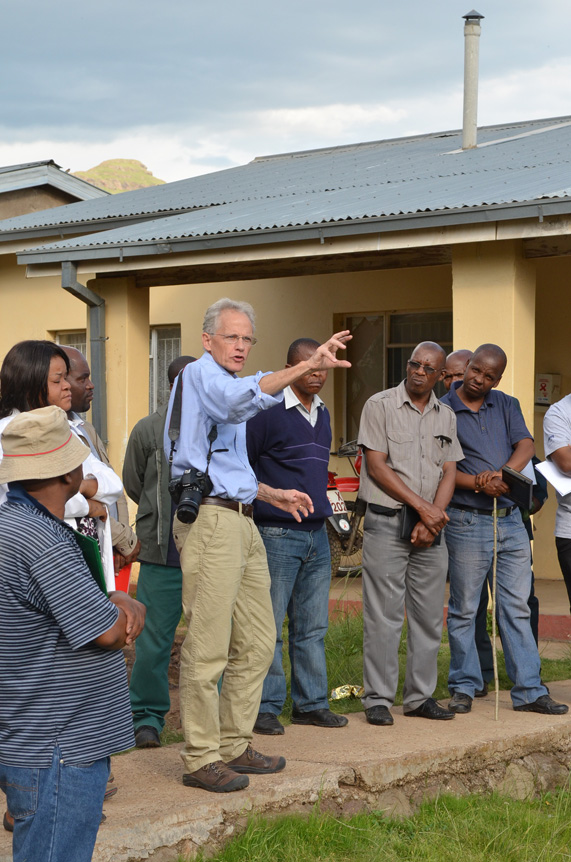
The HOPE Africa staff arrived on Monday with one half of the US team from London. They headed up to the hospital while I waited in Maseru for the other member of US to arrive Tuesday at the airport. HOPE Africa had rented a car for Dr. Ian and I to drive to Mantsonyane. When I arrived at the airport to pick up the rental, to my surprise I found out that the car was a manual! I can count the number of times I've driven a manual car on one finger. So needless to say, I was a little worried about driving up into the mountains in a car that I had no idea how to drive. There were so many things to focus on already with this drive: driving on the left side of the road, herds of sheep and cattle crossing the road, and rockslides around many of the blind turns just to name a few. So when you add in a clutch and a shifter, there was a lot to deal with! I have to say thank you to my Aunt Nancy who let me practice my stick-shift skills on her car one afternoon back in NC, otherwise this trip would have been a disaster! Im happy to say that Dr. Ian and I made it to the hospital without incident.

A group during a Bible study
As I said, US has been a partner and funder of St. James since it opened its doors 50 years ago. It's been one of the longest partnerships that the hospital has had. US, formally USPG, has recently changed their approach to social development and will no longer be funding the hospital. But that's not to say that they will no longer be supporting the hospital. The workshop that we all attended last week was about the new approach that US will be taking with St. James. The approach, called Hands On Health, focusses on strengthening the ties between the hospital and the community it supports. This is done by creating teams comprised of hospital staff and community members that go out into the community on a regular basis and talk with different families about how the hospital and the community coexist. The goal of these visits is to find out about the family in an informal and conversational way. It is in no way like going door to door and taking surveys. It's about creating deep and meaningful conversation between the hospital and community.

Me and Majoro, the Hospital Chief of Staff
The only way that this approach can survive is if the hospital and community want it to happen. It is not an approach that I could come in and implement, or that HOPE Africa could implement. It has to be community based, which is not something that outsiders can create. That being said, we had an overwhelming response from the hospital staff and community. There were probably about 50-60 people at the workshop, and the vast majority of the group was comprised of hospital staff and community members. We spent the workshop going out into the villages surrounding the hospital and getting a feel for the specific format of the visits. It was an incredible introduction to what life will be like when I move up to the hospital. I think the hospital staff was blown away by some of the answers and revelations that came out of the visits. By the end the of the workshop, we had confirmation from both the hospital staff and community members that they wanted to continue with the process. This was fantastic news! They even went as far as creating a list of groups and setting specific dates and times to meet and discuss community visits. Dr. Ian, who led the workshop, said that we got about as concrete of a response as you will ever get with this kind of workshop. And he would know, because he developed this approach while working at a mission hospital in Zambia and has since led workshops like this all throughout the world.

Some Group Building Activities


Dr. Ian Campbell

Driving in the mud!
We had planned on doing one of these community visits at one of the clinics connected with the hospital on Friday morning before we headed back to Maseru. Unfortunately, the weather decided not to cooperate with us and rained through most of the night and morning. This made the road to the clinic impossible to pass. This does not mean that we did not try to pass on it! Once again, I got into the driver's seat of my little manual Ford hatchback and started out on a very muddy and treacherous road to the clinic. This car was a champ. It made it as far as the 4x4 from the hospital made it before the 4x4 got stuck. Then we decided to turn around and head back to the hospital before we were all stuck! How I didn't get stuck in the mud is something I still don't understand. Good work, Ford Figo, good work!

The road to the clinic

My front tire

All in all, it was a fantastic week. I'll be packing and heading up to the hospital this week! I can't wait. My next post will be from Mantsonyane! Sala hantle!
Monday, January 7, 2013

A YASC Family Christmas


Christmas Eve Sunset
Greetings and Happy New Year! I hope you all had as good a Christmas and New Years as I did, because mine was absolutely fantastic. I travelled to Cape Town, SA to visit with nearly all of the other YASCers in Africa. Only one of the African YASCers couldn't make it, so in total we had 7 people in our little entourage. After a little mishap where one of the YASCers got stuck in Rwanda for a day, we all met up in Struisbaai, SA on December 22nd. Struisbaai is about 3 hours east of Cape Town.

Our Beach Condo in Struisbaai
Since there were so many of us coming, we were able to rent a condo at the beach in Struisbaai for dirt cheap. We had to do some bed sharing, but all-in-all it was a really nice set up. We were just a 2 minute walk from one of the most pristine beaches in South Africa. I'd like to say that we spent our time exploring the area and seeing the sights around Struisbaai, but who am I kidding, we spent nearly every day at the beach. Whoops.... Hey, thats what you're supposed to do at the beach, right? We did do some sight seeing though. We took a trip down to the southern most tip of Africa, which is the point where the Atlantic meets the Indian Ocean. Some in the group tried to swim from the Atlantic into the Indian, but the jagged rocks made that a little difficult.

Southern Most Tip of Africa

Christmas Eve Dinner
We had a lovely Christmas Eve braai (cookout). Everyone pitched in and we had a pretty delicious meal. Thanks to Holly's meticulously selected Christmas music playlist, the good food, and good friends I finally started to feel like it was Christmas! We spent the evening reminiscing about Christmases past and family traditions that we would miss this year. It was one of those moments that yanks on your heart stings a little bit. It was very difficult to not be surrounded by family, but I could not have asked for better people to be around! We all slept in a little bit on Christmas morning, and then woke up to make a big Christmas brunch. Once again, when you have 7 people cooking you can make a really good meal with minimal effort. We concluded our brunch with mimosas, because hey, its not brunch without mimosas!

The Beach on Christmas Day
After brunch, we did what any self-respecting person near a beach on Christmas would do, we went to the beach! It was absolutely perfect weather and we even had a dolphin sighting, though I should mention we all thought they were sharks at first and frantically yelled at Cameron to GET OUT OF THE WATER! After a quick afternoon nap, we headed back out to the beach to watch the sunset. We stayed out long after the sun went down and reveled in the moonlit beach. It was the perfect way to end our YASC Christmas.

Sunset on Christmas Day

The Group at Jenny Dick's House
Our time in Struisbaai ended the day after Christmas, so we headed back to Cape Town. Holly is the YASC volunteer in Cape Town and she is also the warden at the Anglican Student house for the University of Cape Town. Since it is the summer break for UCT, there was plenty of room for all of us to stay at the house for the rest our time in Cape Town. We had a long time in Cape Town so we were able to do quite a bit. Winery tours, Cape Town beaches, seeing the wild South African Penguins, hiking Table Mountain, sunsets at Camp's Bay, and much much more. We got to visit with some of the HOPE Africa Staff during our time as well. Jenny Dick and Mpho Mashengete both had the whole group over for lunch on separate days. I can't say thank you to them enough for their hospitality. It's no easy feat to prepare food for 7 hungry missionaries! Thanks again!

Jenny and I at a Camp's Bay Sundown
The View from Table Mountain
Wild Penguins!
One of the Many Wineries We Visited

The Group with the SSM Brothers and Fr. Michael
We also ran into none other than Father Michael Lapsley and several of the SSM brothers from Lesotho when we went to St. George's Cathedral on the Sunday after Christmas. I was not expecting to see so many familiar faces from Lesotho. I was happy that the group got to meet with Fr. Michael and some of the brothers that I work with from time to time. It was an unexpected surprise!


New Year's Eve Picnic at Kirstenbosch Gardens
Our New Year's Eve was a particularly fun night. We got tickets to a jazz concert in Kirstenbosch Botanical Gardens, right at the base of Table Mountain. If you haven't heard of Kirstenbosch, just imagine if you could go to Jurassic Park without the fear of being eaten by a dinosaur. It is breathtakingly beautiful! The opening act was a local Cape Town band, Hot Water, and the main act was Hugh Masekela. We brought a picnic dinner and a few bottles of champagne to enjoy while we danced our way into 2013. It was one of my best New Year's Eves in memory!

It was hard to leave Cape Town and all of my friends. The two weeks we had together has been one of the highlights of my year so far! I'm so grateful to have good relationships while over here. It makes life so much easier to know that I've got friends that are going through the same struggles and challenges that I am and that I can always call on these people to help get me through. Thanks you guys!

I'm back in Maseru now for about another week. I should be headed up to the hospital either this week or next! It's an exciting time, but there is a lot to prepare. This week I'll be working on getting everything ready to move up to Mantsonyane for the next 8 months. I hope you are all having a great start to your New Year. I know that I am!  

A quick shout out to Jenny Korwan because I stole most of the pictures on this blog post from her camera. Thanks Jenny!

Make sure to check out these blogs for more stories and pictures from our trip to Cape Town: HollyJennyCameronSteve, and Benjamin & Elizabeth 

Sala hantle!