St. James is responsible for 7 rural health posts and
clinics in the Mantsonyane area. These clinics provide basic medical services
to the people living around them. The idea of these clinics is to make it
easier for Basotho to access healthcare without having to travel far distances
to the nearest hospital, which in this case is St. James. Clinical services
range from routine treatment of cuts and scrapes, to distribution of drugs, to
HIV/AIDS counseling. It’s quite a large range of services. Some of these
clinics are close to the hospital, and some are very far away. A doctor visits each
of these clinics on a monthly basis, but for the most part, day-to-day
treatment is done by clinical nurses living at the health centers. During my 4
months here (hard to believe it’s been 4 months already!), I hadn’t had a
chance to visit any of the clinics until this week. I got to tag along on two
different trips out to two of the seven clinics.
Ha Mafa Health Post
On Tuesday, I joined the PHC (Primary Health Care)
Coordinator and the Pharmacy director on a trip to the health post in Ha Mafa. Ha Mafa is
about a 30-40 minute car trip over some rough mountain roads. It definitely
requires a 4x4 to get out there. This wasn’t just a normal visit to the clinic,
it was for the monthly vaccination clinic for children under 5. This particular
vaccination clinic is a government-funded project. Vaccinations are free to all
who show up and register. There were easily over 100 people waiting with their
children when we arrived in Ha Mafa. This is a really good turnout, and it’s a
testament to the hard work the village health workers are doing in Ha
Mafa.All sorts of vaccinations
were given out. Polio, Hep B, Measels, etc. Pretty much what a kid gets in the
states. Everyone that showed up to the clinic was given lunch by a Catholic
ministry from a neighboring village, Ha Auray. People are much more inclined to
show up if there’s food provided. I think its great that there’s some
ecumenicalism going on to help get these kids vaccinated!
The PHC Coordinator
Those were not small needles...
Everyone queuing for lunch
The Pharmacy Director (Standing) & one of the
Ha Mafa nurses
These girls were so excited to have their photo taken
Ha Popa Clinic
On Wednesday, I once again joined the PHC coordinator on a new journey out to Ha Popa. Now if I described the road to Ha Mafa as
“rough,” I’m not sure how to describe the road to Ha Popa. I think using the
word “road” might not even be applicable. I guess if we use “road” in the literal
sense of the word, as in “a path connecting one place to another,” it’ll do.
This “road” was absolutely ridiculous. It took about 2 hours to get out to Ha
Popa, and during that 2 hours the car didn’t stop shaking once. If I had been
driving, we would have driven off the mountain within the first 30 minutes! I
took some great video, but the Internet is far too slow to upload it, so you’ll
just have to suffice with a photo for now.
The "road" to Ha Popa
PHC Coordinator in the Ha Popa exam room
The trip to Ha Popa was a regularly scheduled medical officer
visit. Usually this means that a doctor is visiting the clinic, but there was
only one doctor on duty at the hospital that day, so we had to go without him.
We also brought out some medical supplies and drugs to restock the clinic. Now
everyone in the village knows what day the doctor comes because it’s the same
day every month. So when we arrived with only the PHC coordinator, the driver,
and myself it was assumed that I was a new doctor coming out to work. As you
may know, this was not the case. After quickly clearing that
misconception up, the PHC coordinator and the clinic staff got to work seeing
patients. There were roughly 50 patients that showed up that day. I made myself
busy with taking photos and walking through the village. Unfortunately, I’m not
very useful when it comes to things of the medical nature.
It was really great to finally make it out to the clinics
and see the PHC program in action. These clinics are really the first link in
the medical chain here in Lesotho. If you make medical care accessible to the
people, they’re more likely to use it. People are much more likely to take a 20
minute walk to a clinic than they are to take a 6 hour walk to St. James or
another hospital. With the PHC approach, it’s all about getting people in to
seek medical attention. Sometimes that 20-minute walk might be for a simple cut
or bruise, but sometimes that walk makes the difference between life and death.
An early diagnosis of a serious medical condition almost always betters the
chances of treatment and recovery. The clinics can diagnose these serious
conditions, like TB, Diabetes, High blood pressure, HIV/AIDS, and refer someone
to St. James for proper care. I'm so glad I got to visit some of these amazing
centers and see how they work. I’m hoping to make it to all 7 centers before my
year runs out, but the coming winter might prevent that!
The last brave flower of Autumn
Quite the sunset
That’s it for now! My calendar is telling me that I have
less than 3 months left in Lesotho! What!? That doesn’t seem right. Sala
hantle!
I worked for my home diocese’s summer camp, Camp Henry, all
through college. I have so many amazing memories from those 5 summers on staff.
It’s nice to be able to reminisce about those days while I’m here in Lesotho.
One of my favorite times of each summer at Lake Logan was the full moon. I loved
it for many reasons, one being that it made for amazing photography, but the
biggest reason being that each summer it felt like that moonrise was meant just
for me. It's like God was saying, "Hey kid, get a load of this!" I know probably countless people have seen the full moon over Lake
Logan, but every summer it felt like I was seeing something that had never
happened before and that I was blessed to be seeing it. Out of 5 summers full of
memories, the full moon stands out brightly in my mind.
Flash-forward to Lesotho a few months back. I was riding
back to Mantsonyane from Maseru one Sunday evening with Ntate Lekhotla, the
hospital mechanic. I don’t know how it timed out so perfectly, but we arrived
at St. James right as the sun was setting and the full moon was rising over the
mountains surrounding the hospital. The sky was a color of purple that I’ve
never seen before in my life. I can only describe it as the heavens opening. It
is literally one of the most awe-inspiring sites I’ve ever seen. My camera was
either packed away or wasn’t with me so I didn’t get a photo, but from that
point on I was determined to catch this moonrise on film.
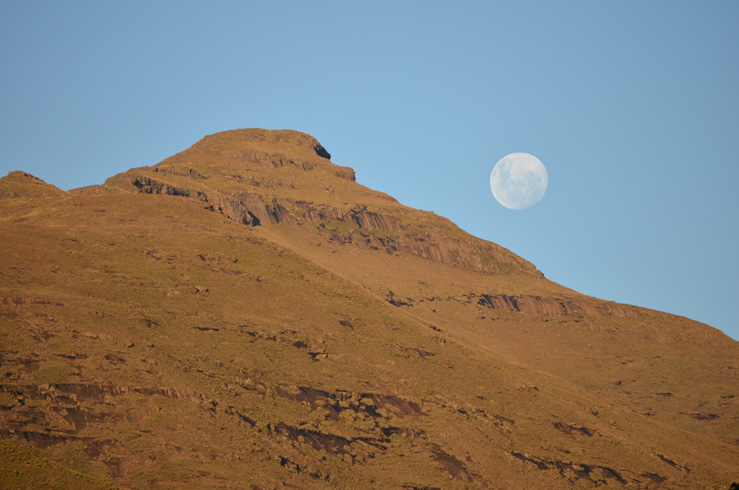
The conditions were finally perfect last week to capture this scene. The sky was not quite the color it was the first time I saw it, but it
was still incredible.Not a day
goes by that the beauty of this country doesn’t blow me away. There’s beauty
not only in the natural surroundings (which I want to point out are ABSOLUTELY
gorgeous), but it’s also in the people and the culture. Make no mistake, life
in Lesotho and especially in the Mantsonyane area is hard. Little to no
employment, little to no transportation available, high sickness rates, and
very cold weather during the winter months to name just a few things. But the
people are resilient. Life is simply at a different pace.
There’s a spot by the river that I’ve been going to
recently. It’s on a high cliff that looks over the river gorge, which is the main
water source for the hospital and surrounding community. I go here and I sit,
and I listen. One thing I love about Mantsonyane is that there is NO background
noise. No airplanes overhead, no far-off cars cruising down the freeway, no
loud music endlessly blasting away (Ok, that last one’s not always true). But
that’s not to say that Mantsonyane is silent. In fact, it’s far from it.
Sitting by the river you’ll hear many things. You’ll hear a herd boy singing
while the bells around his cows’ necks jingle softly. You’ll hear the late
autumn wind blowing down the gorge. You’ll hear the bah-ing chorus of a flock
of grazing sheep high above you on a cliff. You’ll hear a village singing just over
the ridge and the women giving their powerful ululations. Plain and simple, you’ll hear
life. It’s a life that hasn’t changed in a very long time, and it is
overwhelmingly beautiful.
Thomas Merton once said that, “Every moment and every event
of every man’s life on earth plants something in his soul.” My life, compared
to most of the world, is not normal. Even by American standards, it’s not
normal for someone to pack up and move half way across the world (not to
mention doing it again next year!).But what I’ve found is that God finds ways to show me how blessed I
truly am, no matter where I might be. Whether it be on the field at Lake Logan
during the summer’s full moon, on a cliff high in the Maulti’s watching the
same full moon rise over the mountains, or sitting over the river listening to
the sounds of a life very different from my own. God always finds ways to plant these things in my soul. Blessed doesn’t even begin
to describe how I feel. Until next time, Sala hantle.
Greetings! I hope your Easter was filled with immeasurable
joy and love! I was fortunate enough to spend my Easter holiday in Kenya with
Jenny Korwan, the YASCer in Nairobi. Jenny is working in the Nairobi area with
an NGO called Tatua Kenya. Before I get into all the cool stuff we did while I
was there, I want to make a quick appeal for you to all visit my fundraising section! My mission with YASC can’t happen without your financial support.
Please give today! Now back to the blog post.
I arrived in Nairobi on the Monday of Holy week. Jenny works for a community development organization. They work with several
different projects in the Nairobi area, including many children’s homes. For my
first couple of days in Kenya, we went to visit several of these homes. It was
really cool to see how Jenny works and get another prospective of the YASC
program. I love the fact that all the YASCers are in such different places
doing very different things, but we are still having very similar experiences.
Jenny with the boys from Tumaini
It never ceases to amaze me what the human spirit can
endure. Most of the kids in these children’s homes have gone through things
that are unimaginable and incomprehensible. Things that no child should ever
have to go through. Yet they still wear the biggest smiles on their faces.
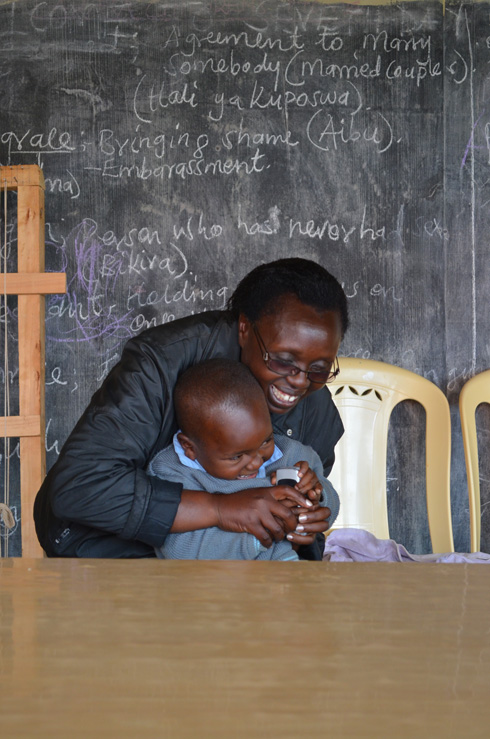
Smiles that warm the hearts of everyone they meet.I’m in awe of their strength. I’m also in awe of the hearts
of the caregivers at these children’s homes. They are without a doubt some of
the kindest souls I’ve ever met. Like Moraa from the Furaja home, or Charles
from Tumaini. God is working everywhere in the world, but there are some places
where it’s just easier to see. People like Moraa and Charles are angels among
us.
Charles from Tumaini
Moraa from Furaja
Jenny and Jacob leading a class at Dreams
Children's Home
A girl from Dreams
(Insert Lion King reference here)
It was great to see the part of Kenya that Jenny works and
lives in everyday, but we also got to do some touristy things as well. For
example: SAFARI! Did you know: Safari is Swahili for journey? O man, was it
cool. We were picked up in Nairobi by our Safari driver in what was, more or
less, a minivan on steroids. We then drove about 6 hours to the Masai Mara game
reserve. The Masai Mara is one of the favorite game reserves in Kenya. It’s
smaller than all the rest, so you get see almost everything without having to
travel long distances. Though I can’t say for sure, this is probably where
Disney came to make the Lion King. Spot on classic Africa feel. We saw so much!
They refer to the large animals in game reserves as the Big 5 (Lions, Leopards,
Rhinos, Buffalo, and Elephants). We saw 4 of the big 5, which is really good
for one park. The only one we didn’t see was a rhino, but we got to see a
leopard! They are extremely rare to see in the wild. We also got to see lions
eating not once, but twice. Another rare occurrence! Take a look at the video I
shot below. Lion cubs shouldn’t be so adorable while feasting on that buffalo,
but they sure are!
Too close for comfort, but sooooo cool!
If you look hard enough, you'll see a Leopard
He tried to snuggle with his wife. She did not want to.
He wasn't very happy about that...
Our Safari Tent
We also got to see other really cool animals. I’ll try to
name them all: Gazelle, Impala, Giraffes, Hyenas, Wart hogs, Meer cats,
Monkeys, Wildebeests, Hippos, and probably more that I’m forgetting. We Safari’d for 3
days and 2 nights. Each day the driver would take us into the park and drive us
around to all the cool spots, and then take us out to an awesome tent camp
where we stayed. It was really an awesome experience!
Monkeys are so cool!
Our Safari Chariot
On the Kenya/Tanzania border in the Masai Mara
During our YASC training in Toronto last July, the YASC
group met missionaries from the ELCA that were also preparing to leave for overseas
service. Mike and Leslie were part of this group and were also placed in
Nairobi! They’ve pretty much adopted Jenny as their Kenyan daughter while she’s
there. Mike is the pastor at a Lutheran Church in the Nairobi area. We went to
Mike’s church on Maundy Thursday, and then joined them for dinner at an
Ethiopian restaurant! It was great to see both of them again and to
catch up!
Easter weekend was quiet and relaxing, but could have been very different. As you may know, the
Kenyan elections took place in early March. Everyone had been on edge about
them since the 2007 elections turned violent and deadly. The 2013 elections turned
out to be relatively peaceful, but were extremely close. Raila Odinga contested
Uhuru Kenyatta’s victory in court, which dragged out the election process. The
court announced its decision on the election the Saturday before Easter. We had
been advised to stay inside until the courts made their announcement, so Jenny
and I had a quiet Saturday at her house. Thankfully, everything was peaceful. The
court upheld Kenyatta’s win. (Side note: Uhuru Kenyatta is currently under
indictment from the ICC for inciting violence during the 2007 Kenyan elections.
He is the first sitting head of state to be under indictment by the ICC. They
are saying that he will have to be at The Hague for most of his presidency.)
For Easter, we headed back to Mike and Leslie’s church.
Afterwards, we had brunch with another Episcopal Missionary in Kenya, Zach
Drennen. The church is quite far from where Jenny lives, and travel in Nairobi
is a nightmare, so we stayed in town and went to a movie. Yes that’s right, a
movie. In a movie theater! This might not be as exciting to you as it was to me, but
I haven’t been to a movie theater since I left The States so cut me some slack.
After that, we had dinner with Jenny’s boss, Natalie.
Nairobi traffic. Where does it start? Where does it end?
Only God knows. And maybe a few taxi drivers...
There’s so much stuff that we did while I was in Kenya and
it’s hard to make it all fit in a blog post! I’ll mention some of the stuff
quickly though. Kissing Giraffes, feeding crazy yet adorable monkeys (see video
below), lunch with people from the community, sitting in traffic, visits to the
immigration department, sitting in traffic, and much more! Did I mention sitting
in traffic? For all of you back home who think your morning commute is bad,
come to Nairobi. You’ll forget all about your traffic worries. Nairobi
takes traffic to the next level. It’s anywhere and everywhere, and for no
reason at all. A trip that should realistically take you 15 minutes can take
up to 2 or 3 hours. And there’s no getting around it. You just have to deal
with it. It’s nice to be back in Lesotho where the only traffic is caused by
herds of animals crossing the road!
Yummy!
She didn't even buy me dinner first!
Feisty little critters
But adorable as well
Lunch at Tumaini
All in all, it was a fantastic trip! I’m extremely blessed
for the opportunities that YASC is giving me. Thanks to Jenny Korwan and the
Tatua staff for putting up with me for 2 weeks. Also, did I mention I’m 23 now?
Seems impossible, but it’s true. Thanks for everyone who sent me birthday
wishes! That’s all for now. Sala hantle!
One of the many challenges of living in a rural mountain
community in Lesotho is cooking. Unlike the United States, there isn’t a
supermarket or Walmart around every corner. Produce isn’t shipped from
halfway around the world to fill the shelves with every vegetable known to man,
regardless of the season. The food I can buy, for the most part, is produced
and sold in Lesotho, with the exception of a few South African brands. The food
chain is much shorter and I really appreciate that fact.
A sheep kept to feed the Hospital patients
The Basotho diet is a rather simple one. It’s very high in
starches and animal protein, and fresh vegetables are eaten during season. A
staple food is a dish called Pap. Pap is made from cornmeal cooked into a thick
brick. It would be like if you left your grits on the stove for just a few
minutes too long and they became solid. A typical meal would be pap with meat,
usually mutton, goat, chicken, or beef. It’s simple and really filling.
A bull being fattened for the Hospital's 50th Anniversary
People in the Mantsonyane area are typically subsistence
farmers. Pretty much all the land around the hospital is farmland. It looks to
be a continuous crop, but the land is separated and different sections are
allocated to certain people. This separation isn’t noticeable so you have to be
“in the know.” The chief of a village is in charge of allocating the farmland
to his/her villagers. Typical crops grown are corn, wheat, carrots, onions,
peppers, potatoes, tomatoes, spinach, and most other things you’d find in an
American garden.
Can you tell where the land is
separated? I know I can't
I should and could devote this entire blog post to bread,
but I won’t. Basotho love bread and are fantastic at making it. Baked bread,
fried bread, sweet bread, scones, biscuits, muffins, and many more delicious
concoctions. It’s surprising to me that I haven’t gained 20lbs just from the
bread alone!
The Hospital tuck shop
As I said, there isn’t a supermarket right around the
corner. It’s takes 45 minutes of walking to get to the store in town and back,
but luckily the hospital has a small store with essentials so I can limit my
trips to Mantsonyane to once a week. The shop I usually go to in town is called
Frasers and it has a little bit of everything, but it's mostly dry goods. There’s
one vegetable stand that I like to stop at and pick up some produce. It’s a
limited selection, but its always quality! In season right now are peppers,
potatoes, tomatoes, carrots, and onions. It’s not a lot of variety, but you can cook a lot
with those ingredients.
The road to town
Meat is a lot harder to come by. Most people own their own
animals that they’re keeping for slaughter, so there’s not really any place to
buy meat in town. Frasers sells industrial size bags of various frozen meats,
but I don’t have a refrigerator to keep it fresh. So I’ve been eating mostly
vegetarian since I moved up here. Any one that knows me well will balk at that
statement! With such a limited ingredient selection, I’ve cooked those
ingredients in more ways than you can shake a stick at to keep the illusion of
variety. One dish that has been quite tasty is a vegetable curry, complete with
homemade flatbread. Is it a traditional curry? Not even close. Is it delicious?
Absolutely.
South African Margarine + Lesotho Flour + South
African Milk = Delicious flatbread
Don't have a rolling pin? Use a Nalgene!
Curry powder
The finished product
In other news, you might have noticed that I’ve added a
fundraising section on the blog to help raise the money I need to go to Rome
next year. I’ve set up a Paypal account so that people can make a quick and
easy online donation. Make sure to visit the fundraising section to find out
how you can help!
In other, other news, I’m headed to Kenya next week for a
little vacation time! I’ll be staying with the YASCer in Kenya, Jenny Korwan. I
could not be more excited! I’ll be sure to post photos when I get back! Sala
hantle!